
Optical Filters in LiDAR and Laser Technology
While lasers have long been integral to defense applications, their impact now spans manufacturing, environmental monitoring, biomedical imaging, aerospace, and autonomous systems. At the core of these laser-based systems are optical filters, precision components that control light transmission, block unwanted wavelengths, and enhance measurement accuracy. However, wavelength isn't the only consideration. Filter selection is driven by multiple factors including system constraints, environmental conditions, laser type, detector characteristics, and wavelength-specific challenges.
Critical Optical Design Considerations for Laser Systems
Effective filter design requires understanding the complete optical system, not just isolated component specifications. Engineers must consider:
- Laser type (continuous wave vs. pulsed) and its impact on coating durability
- Detector sensitivity and spectral response characteristics
- Optical system architecture including beam paths and component integration
- Environmental conditions including temperature extremes, humidity, and contamination exposure
- Angle of incidence (AOI) effects, as AOI sensitivity can be as critical as center wavelength in determining filter performance
- Temperature stability and spectral drift, particularly for outdoor LiDAR and industrial laser systems operating across wide temperature ranges
- Solar background interference in outdoor applications
- Laser damage threshold requirements based on power levels and pulse characteristics
Many advanced laser systems require custom filter designs optimized for the specific combination of laser source, detector, and operating environment.
Understanding Wavelength-Specific Filter Requirements
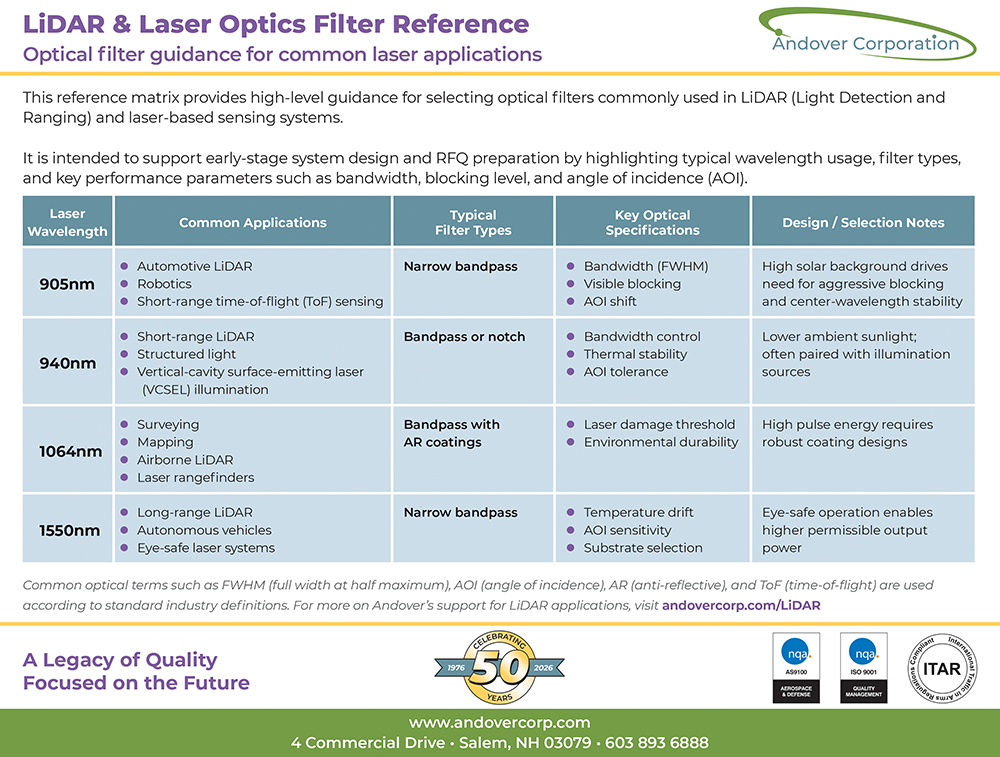
Different LiDAR and laser applications operate at distinct wavelengths, each presenting unique optical challenges. This guide explores four core wavelengths commonly used in modern laser-based systems: 905 nm for automotive LiDAR and robotics, 940 nm for short-range LiDAR and structured light, 1064 nm for surveying and airborne mapping, and 1550 nm for eye-safe, long-range applications.
905 nm: Automotive LiDAR and Robotics
Automotive LiDAR and short-range time-of-flight (ToF) systems predominantly operate at 905 nm, where high solar background radiation presents significant challenges. Engineers  designing for this wavelength must prioritize:
- Narrow bandpass filters with aggressive visible blocking to reject ambient sunlight
- CWL (center wavelength) stability to maintain performance across temperature variations
- AOI shift compensation, as angle of incidence often matters more than center wavelength alone in real-world deployments
- High signal-to-noise ratio optimization to distinguish laser returns from solar interference
The intense solar background at this wavelength requires filters with exceptional out-of-band blocking while maintaining high transmission within the narrow passband.
940 nm: Short-Range LiDAR and Structured Light
Short-range LiDAR, structured light systems, and VCSEL-based applications at 940 nm benefit from reduced ambient sunlight compared to 905 nm, but still demand tight spectral control. Typical specifications include:
- Bandpass or notch filters with precise bandwidth control
- Thermal stability to maintain performance across operating temperature ranges
- Compatibility with illumination sources, as these systems often pair filters with active illumination
While solar interference is lower at 940 nm, engineers cannot compromise on spectral precision, even short-range systems require filters engineered for consistent performance.
1064 nm: Surveying, Mapping, and Airborne LiDAR
Industrial surveying, topographic mapping, and airborne LiDAR systems operating at 1064 nm face distinct challenges related to high pulse energy and demanding  environmental conditions. Critical filter specifications include:
- High laser damage threshold capable of withstanding intense pulsed laser power
- Robust thin-film coatings that prevent optical degradation over time
- Bandpass filters with anti-reflection (AR) coatings to maximize transmission efficiency
- Durability for harsh environments, including extreme temperatures, humidity, and mechanical stress
At this wavelength, coating durability is paramount, filters must maintain peak precision and longevity under continuous high-power operation in industrial and aerospace applications.
1550 nm: Eye-Safe, Long-Range LiDAR
Long-range LiDAR for autonomous vehicles and high-performance sensing systems increasingly utilize 1550 nm wavelengths due to eye-safety advantages that enable higher power levels. This wavelength presents unique optical design constraints:
- Narrow bandpass filters engineered for minimal temperature drift
- Careful substrate selection to manage AOI sensitivity and thermal expansion
- Precision coating design to maintain spectral stability across wide temperature ranges
- Enhanced signal clarity while minimizing interference from background light
Eye-safe operation at 1550 nm allows system designers to increase laser power for extended range, but this advantage is only realized with optical filters that maintain performance under demanding conditions.
Key Attributes of High-Performance Laser Optical Filters
Superior laser optical filters share several characteristics that distinguish them in demanding applications:
Custom Engineering: Filters tailored to specific wavelengths, bandwidths, substrate requirements, and environmental constraints rather than off-the-shelf solutions.
Vertical Integration: Complete control over coating design, deposition, and quality control ensures consistency and enables rapid iteration during development.
Environmental Durability: Coatings engineered to withstand temperature extremes, humidity, salt fog, abrasion, and mechanical stress throughout the product lifecycle.
High Laser Damage Threshold: Robust thin-film structures capable of handling intense laser power without degradation, critical for pulsed laser applications.
Flexible Manufacturing: The ability to support everything from single prototype filters for R&D through high-volume production without minimum order requirements.
Conclusion
From autonomous vehicle LiDAR at 905 nm and 1550 nm to industrial laser processing at 1064 nm and precision medical diagnostics, optical filters remain essential to laser system performance. However, effective filter selection requires understanding wavelength-specific challenges, system constraints, and real-world operating conditions.
Engineers designing LiDAR and laser-based systems must look beyond simple wavelength matching to consider solar background rejection, angle of incidence effects, temperature stability, and laser damage threshold. Custom engineered optical coatings that account for these factors are key to optimizing system performance, reliability, and longevity.
Click to download - LiDAR & Laser Optics Filter Reference 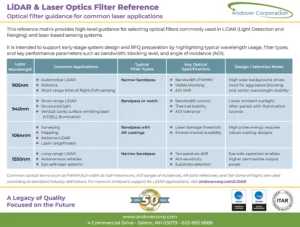
Andover Insights & Innovations
Discovering new possibilities in optical filtering

Celebrating Women in Optics: María Josefa Yzuel


Contact Our Team
Ready to discuss your optical needs? Whether you're looking for a quote or have technical questions, our expert team is here to help guide you to the perfect solution.