Beamsplitters and Prisms

High-Accuracy Splitting Across UV, VIS, and IR
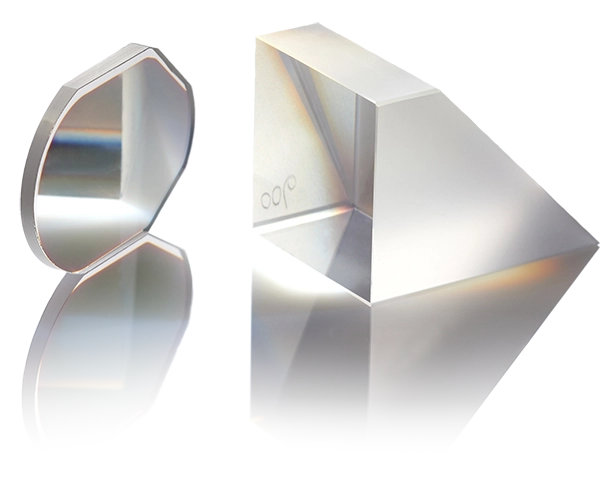
Laser beamsplitter with coated optical surface, shown in a close-up studio shot.

Andover Beamsplitters

Precise wavelength and ratio control

Beamsplitter Basics
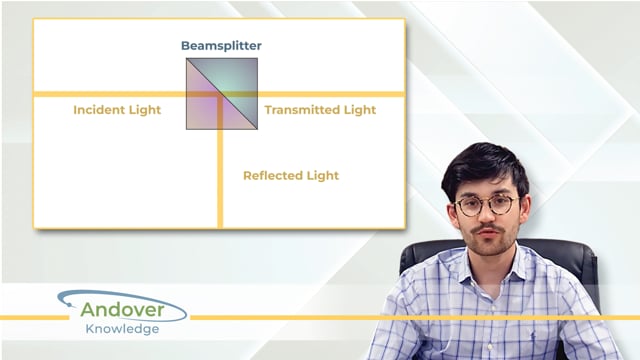
Video
Play Video

Optical beamsplitters are precision components that split incident light into separate paths or combine multiple beams into a single optical path. Andover Corporation supplies high-precision beamsplitters engineered for demanding optical systems used in aerospace, defense, biomedical imaging, and scientific instrumentation.

Key features

  • Custom reflection / transmission (R/T) ratios to match system requirements
  • Broad wavelength coverage for UV, visible, and IR designs
  • Polarizing and non-polarizing options
  • Cube and plate configurations for flexible integration
  • Durability and environmental stability for challenging operating conditions
  • Precision thin-film coatings to support consistent optical performance

Common beamsplitter applications

Andover beamsplitters are used in optical assemblies and systems where reliable beam control, wavelength separation, and signal management are required, including:

  • Aerospace systems:
    Supports navigation, stabilization, and imaging payloads in airborne and spaceborne platforms.
  • Defense and targeting systems:
    Enables optical paths for laser designation, rangefinding, and surveillance workflows.
  • Astronomical instruments:
    Helps manage light paths for spectrometry, imaging, and precise wavelength separation in observatory systems.
  • Biomedical imaging:
    Used in fluorescence microscopy, endoscopy, and diagnostic instruments that require dependable spectral separation.

Types of Beamsplitters

Beamsplitters are classified by function into non-polarizing, polarizing, and wavelength-selective types. Each type is engineered to split light based on intensity, polarization state, or spectral properties, depending on the application.

Standard

Designed to split unpolarized light at specific R/T ratios, these beamsplitters are ideal for general-purpose applications.

Polarizing

These separate light into S and P polarization states, making them suitable for applications requiring polarization control.

Non-Polarizing

Engineered to maintain the polarization state of light while splitting it, these are used in systems where preserving polarization is critical.

Dichroic

Utilize wavelength-specific coatings to split light by wavelength, commonly used in fluorescence and multi-spectral imaging.

Beamsplitter Configurations

Cube and plate beamsplitters are the two primary types, each designed to divide light by reflection and transmission. Cube beamsplitters offer compact integration and minimal beam shift, while plate beamsplitters are lightweight, cost-effective, and easier to manufacture in larger sizes.

Cube

Constructed by cementing two right-angle prisms together with a partially reflective coating on the hypotenuse of one prism.

  • No beam shift

  • Equal optical path lengths for transmitted and reflected beams

  • Compact and robust design

Plate

Flat glass substrates with a partially reflective coating, optimized for a 45° angle of incidence.


  • Lightweight and easy to integrate

  • Suitable for applications where beam displacement is acceptable

Explore our Beamsplitter Product Line or Request a Quote for custom solutions tailored to your specific needs.

Frequently Asked Questions

What is the difference between polarizing and non-polarizing beamsplitters?
Can I get a beamsplitter with a custom R/T ratio?
What is the typical wavelength range for your beamsplitters?
How do I choose between a cube and a plate beamsplitter?
Do you offer beamsplitters for high-power laser applications?

From Prototype to Production

Custom Fabrication and High-Volume Manufacturing

Our vertically integrated facility handles both specialized custom projects and large-scale production runs with consistent quality and short lead times.

Quality isn't just a metric

- it's our foundation.

0 %
On-Time Delivery Rate
Delivering Precision, On Schedule
0.5 %
Return Rate
Industry-leading quality
0 %
Traceability
Complete documentation

Andover Insights & Innovations

Discovering new possibilities in optical filtering

Digital elevation model. GIS product made after proccesing aerial pictures taken from a drone. It shows city urban area with roads and suburbs

Optical Filters in LiDAR and Laser Technology

While lasers have long been integral to defense applications, their impact now spans manufacturing, environmental monitoring, biomedical imaging, aerospace, and...
elegant glass disc shapes reflecting light in vibrant tones, futuristic abstract 3D render --chaos 30 --ar 16:9 --v 6.1 Job ID: dfe3bd58-a7cd-4092-bcac-e704984ad047

Understanding Optical Filter Cost Drivers: A Technical Guide

Optical filters serve as critical components in imaging, sensing, and detection systems across industries from biomedical instrumentation to aerospace. While...
BEAM Series: Trends in optics for Laser-Based Technology

BEAM: Breakthroughs – How Andover Corporation’s Advanced Coating Technology Powers NASA’s PUNCH Mission

In the demanding realm of space-based solar observation, precision optical components must withstand extreme conditions while delivering uncompromising performance. NASA's...

Contact Our Team

Ready to discuss your optical needs? Whether you're looking for a quote or have technical questions, our expert team is here to help guide you to the perfect solution.