
Germanium Alternatives For IR Optics
Rethinking Germanium in Infrared Optical Design
As germanium (Ge) availability, pricing, and supply chain constraints continue to impact infrared (IR) optical manufacturing, engineers are increasingly evaluating alternative substrate materials and optical designs.
However, replacing germanium is not always a direct material substitution. Each infrared application presents unique requirements for wavelength transmission, thermal stability, environmental durability, optical performance, and manufacturability.
Exploring Alternatives to Germanium
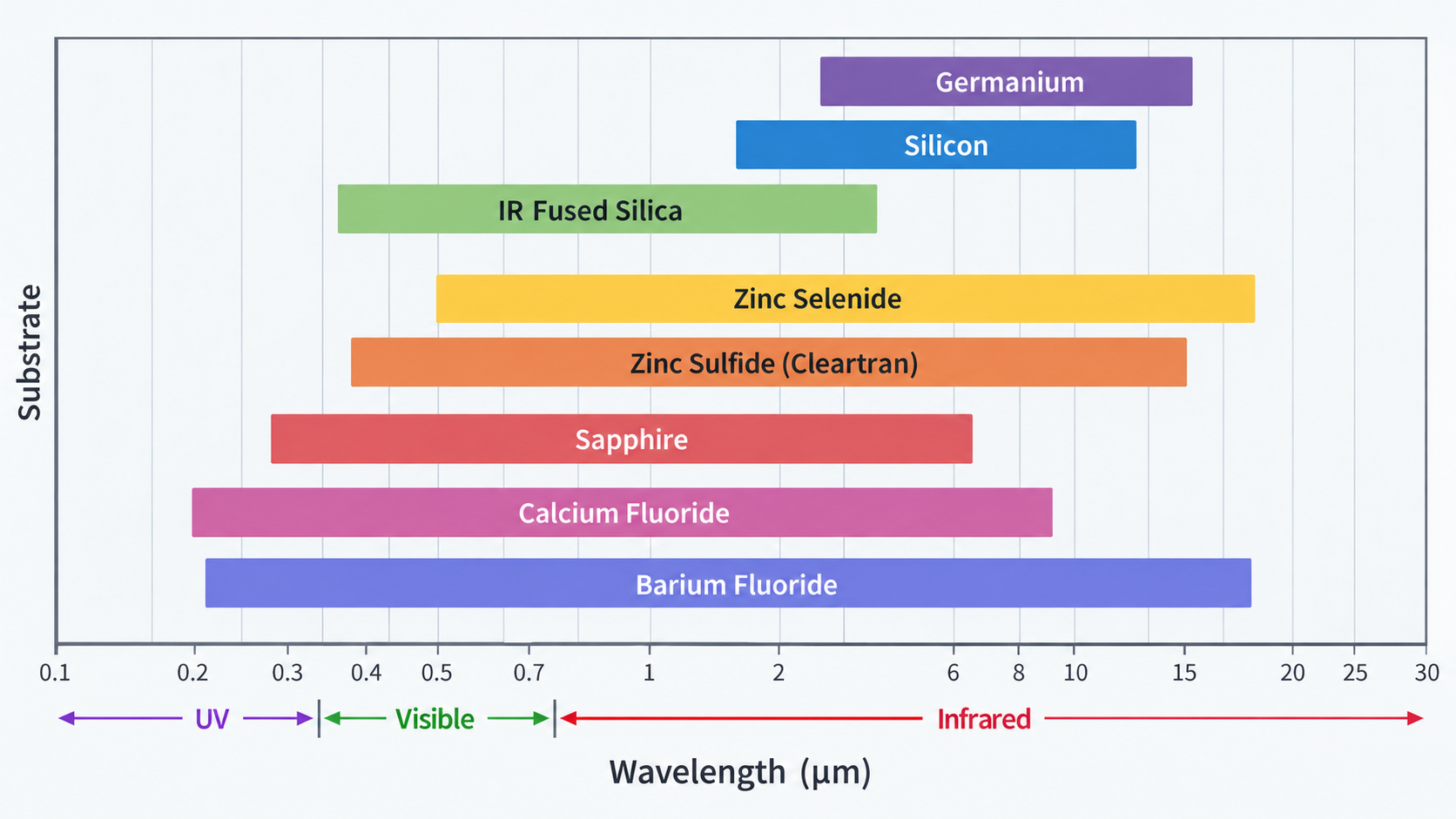
Germanium remains an important material for infrared optical systems, particularly in long-wave infrared (LWIR) applications. However, depending on the operating wavelength and system requirements, other infrared-transmitting materials may offer viable options.
Silicon (Si): Silicon is commonly used in near-infrared (NIR) and mid-wave infrared (MWIR) optical applications, including systems operating in the 3–5 µm band. Its mechanical properties and established manufacturing infrastructure make it worth evaluating where spectral requirements permit.
Zinc Selenide (ZnSe): Zinc selenide offers broad infrared transmission and is commonly used in thermal imaging, infrared windows, spectroscopy, and CO₂ laser systems. Its optical properties can make it suitable for applications requiring transmission across portions of both the MWIR and LWIR regions.
Zinc Sulfide (ZnS): Zinc sulfide is used in infrared windows, imaging systems, and demanding optical environments. Depending on the grade, ZnS can support applications requiring infrared transmission, with certain multispectral grades also offering visible-range transmission.
Chalcogenide Glass: Chalcogenide glasses represent a family of infrared-transmitting materials with compositions designed for different spectral and manufacturing requirements. Certain formulations can support LWIR imaging and precision-molded optical components, making them candidates for compact or higher-volume infrared systems.
Material suitability depends on the operating wavelength, substrate grade, component geometry, coating design, and environmental requirements. Alternatives must be evaluated against the specifications of the complete optical system
Frequently Asked Questions
Should germanium availability influence an optical design?
Yes. Material sourcing should be evaluated alongside optical performance, environmental demands, manufacturability, and production needs. The ability to obtain germanium for one build should not replace a review of the quantities, schedule, and long-term sourcing assumptions associated with your program.
Is there a drop-in replacement for germanium in IR optics?
No alternative should be assumed to replace germanium without application-specific evaluation. Andover Corporation evaluates the substrate, coating, fabrication approach, and system constraints together. A proposed material change requires verification against your spectral, mechanical, environmental, and qualification requirements.
What is application-driven optical engineering?
Application-driven optical engineering starts with the optic's required function and operating conditions, then develops the design around those needs. Andover Corporation uses that approach to connect material evaluation, coating architecture, fabrication, and performance validation from concept through production.
Can I contact Andover before selecting an optical substrate?
Yes. Andover Corporation can help evaluate your application before you select a substrate or finalize a drawing. Share your required optical function, known performance targets, system constraints, and production needs. The engineering team can help define the remaining requirements and evaluate a path forward.
How is a custom optical solution validated?
A custom optical solution is validated against agreed acceptance criteria using appropriate inspection, metrology, and spectral testing. Andover Corporation also evaluates environmental and durability requirements as applicable. Documentation, traceability, and production quality control support the transition from an evaluated design to manufactured components.
From Prototype to Production
Custom Fabrication and High-Volume Manufacturing
Collaborate with Andover Corporation on custom optical products, prototype development, and specialized optical solutions supported by vertically integrated manufacturing.
With in-house fabrication, coating, assembly, and metrology capabilities, Andover can support everything from rapid prototypes to high-volume production programs with responsive lead times and consistent quality.