
Understanding Optical Filter Cost Drivers: A Technical Guide
Optical filters serve as critical components in imaging, sensing, and detection systems across industries from biomedical instrumentation to aerospace. While performance requirements are paramount, understanding the cost drivers behind precision optical coatings enables engineers to make informed design decisions that optimize both functionality and budget.
The Cost-Performance Balance
With decades of experience in precision optical coatings, we've identified that the key to cost-effective filter design lies in specification optimization. Over specification (requesting tighter tolerances or broader performance ranges than your application requires) is the most common source of unnecessary expense. The challenge is determining which parameters are truly essential for system performance.
Primary Cost Drivers in Optical Filter Manufacturing
1. Performance Specification Complexity
The technical requirements of your filter directly impact manufacturing complexity and cost:
- Bandwidth precision: Ultra-narrow bandwidths (< 10 nm FWHM) require lower yields, additional coating layers, and tighter process control compared to standard bandpass filters
- Edge steepness: Steep transition slopes between passband and stopband demand advanced deposition techniques and extended production time
- Transmission efficiency: Achieving >90% peak transmission while maintaining deep blocking requires careful material selection and layer optimization
- Blocking range and depth: Extended spectral blocking (e.g., UV through NIR) with high optical density (OD 6+) increases coating stack complexity and coating run length exponentially
Before finalizing specifications, assess which performance parameters directly impact your system's measurement accuracy or signal-to-noise ratio. Parameters that don't contribute to these metrics represent opportunities for cost reduction.
2. Light Source Characteristic
Your illumination source provides 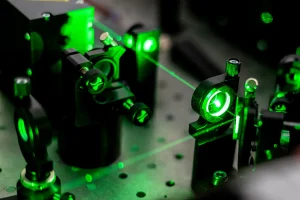 natural constraints that can simplify filter design
Many light sources emit within defined spectral windows, LEDs have 20-50 nm bandwidth, lasers offer narrow line emission, and broadband sources like xenon lamps have characteristic spectral profiles. By characterizing your source's actual output spectrum, you can specify blocking ranges that match real-world needs rather than theoretical extremes.
For example, if your NIR LED source emits between 800-900 nm with negligible output beyond this range, specifying blocking from 400-1500 nm adds unnecessary coating layers compared to a 400-950 nm specification
3. Detector Sensitivity Range
Detector spectral response defines the functional blocking requirements:
Silicon-based detectors (CCD, CMOS) have negligible sensitivity beyond 1100 nm, while InGaAs detectors operate in the 900–1700 nm range. Photomultiplier tubes typically respond only below 900 nm. Liquid-nitrogen–cooled microbolometers, used for long-wave infrared detection, extend sensitivity into the 3–7 µm region—well beyond the range addressed by standard interference coatings. Specifying blocking anywhere outside a detector’s true response band adds coating complexity without improving signal discrimination.
Consider a fluorescence imaging system using a silicon CCD: blocking specified to 1200 nm provides complete protection, while extending to 2000 nm increases manufacturing cost by 15–25% with no functional benefit.
4. Dynamic Range Optimization
System dynamic range depends on the ratio between peak transmission and blocking depth:
Dynamic range (dB) = 10 × log₁₀[(T_peak / 100) × 10^OD]
Where T_peak is peak transmission percentage and OD is optical density of blocking.
A filter with 95% transmission and OD 4 blocking provides 39.8 dB dynamic range, while 70% transmission with OD 5 blocking yields 48.5 dB. In many applications, accepting slightly lower transmission in exchange for deeper blocking simplifies manufacturing and reduces costs by 20-30% while improving overall system performance.
This trade off is particularly valuable when detector noise or background signal, rather than transmission loss, limits system sensitivity.
5. Environmental Operating Conditions
Physical environment significantly influences coating material selection and design:
- Temperature extremes: Cryogenic or high-temperature operation (beyond -20°C to +70°C) may require specialized coating materials with matched thermal expansion coefficients
- Humidity and contamination: Corrosive atmospheres, salt spray, or chemical exposure necessitate protective overcoats or hermetic sealing
- Mechanical stress: Vibration, shock, or contact cleaning requirements demand hard coating technologies such as ion-assisted deposition
- Angle of incidence: Non-normal incidence (>10° from perpendicular) causes spectral shifts that must be compensated through design, adding complexity
Filters for benign laboratory environments cost significantly less than those engineered for industrial process monitoring or outdoor deployment.
6. Coating Technology Selection
Multiple deposition technologies can achieve similar specifications with different cost profiles
- Magnetron sputtering:
 Excellent for durable, environmentally stable coatings with moderate complexit
 - Ion-assisted deposition (IAD): Produces dense, hard coatings with superiorenvironmental resistance
- Electron-beam evaporation: Cost-effective for simpler coating designs with standard materials
- Plasma-enhanced processes: Enable advanced designs with precise layer control
- Thermal Physical Vapor Deposition (PVD): High throughput for less stringent applications
Remaining flexible on coating technology, focusing on performance outcomes rather than specific processes, allows manufacturers to select the most cost-effective approach for your application. In some cases, hybrid processes combining multiple technologies optimize both performance and cost.
Strategic Procurement Considerations
Volume and Timing
Filter costs decrease substantially with production volume:
- Prototype quantities (1-10 units): Full engineering and setup costs amortized over few parts
- Production runs (50-500 units): Setup costs distributed, improved pricing on substrate materials
- Volume production (500+ units): Maximum efficiency in coating runs, optimized material utilization
Planning for future needs and consolidating orders can reduce per unit costs by 40-60% compared to repeated small lot purchases. Early engagement with your filter supplier enables production planning that aligns with your project timeline while optimizing manufacturing efficiency.
Substrate Considerations
While often overlooked, substrate selection impacts total filter cost:
- Material: BK-7 for visible - NIR or standard fused silica offers excellent UV-NIR transmission at lower cost than specialized materials like sapphire or calcium fluoride
- Dimensions: Standard sizes (12.5 mm, 25 mm diameter) reduce costs compared to custom dimensions requiring dedicated grinding
- Thickness and parallelism: Relaxing tolerances where optical path requirements permit reduces fabrication time
- Surface quality: Specifying 40-20 scratch-dig rather than 10-5 significantly reduces substrate costs unless application demands higher quality
Design Collaboration for Cost Optimization
The most cost-effective filters emerge from early collaboration between system designers and coating engineers. Key information to share includes:
- Complete system architecture (source, optical path, detector)
- Critical performance metrics versus desired specifications
- Operating environment and handling requirements
- Production volume projections and timeline
- Budget constraints and target pricing
This dialogue enables identification of specification areas where relaxed tolerances have minimal system impact but significant cost benefits. In many cases, alternative design approaches can achieve equivalent system performance at substantially lower cost.
Conclusion
Optimizing optical filter costs requires understanding the relationship between specifications and manufacturing complexity. By focusing on application essential performance parameters, leveraging knowledge of your optical system's components, and maintaining flexibility in technical approach, you can achieve the performance your application demands while controlling costs.
Effective cost optimization begins with early supplier engagement, complete system information sharing, and collaborative problem solving between optical designers and coating engineers. This partnership approach consistently delivers superior cost performance outcomes compared to rigid specification based procurement.
Andover Insights & Innovations
Discovering new possibilities in optical filtering

Light Reveals the World. We Refine the View.

Contact Our Team
Ready to discuss your optical needs? Whether you're looking for a quote or have technical questions, our expert team is here to help guide you to the perfect solution.